
.svg)
.svg)

.png)
SEO

Christopher Smith
05 Feb 2025
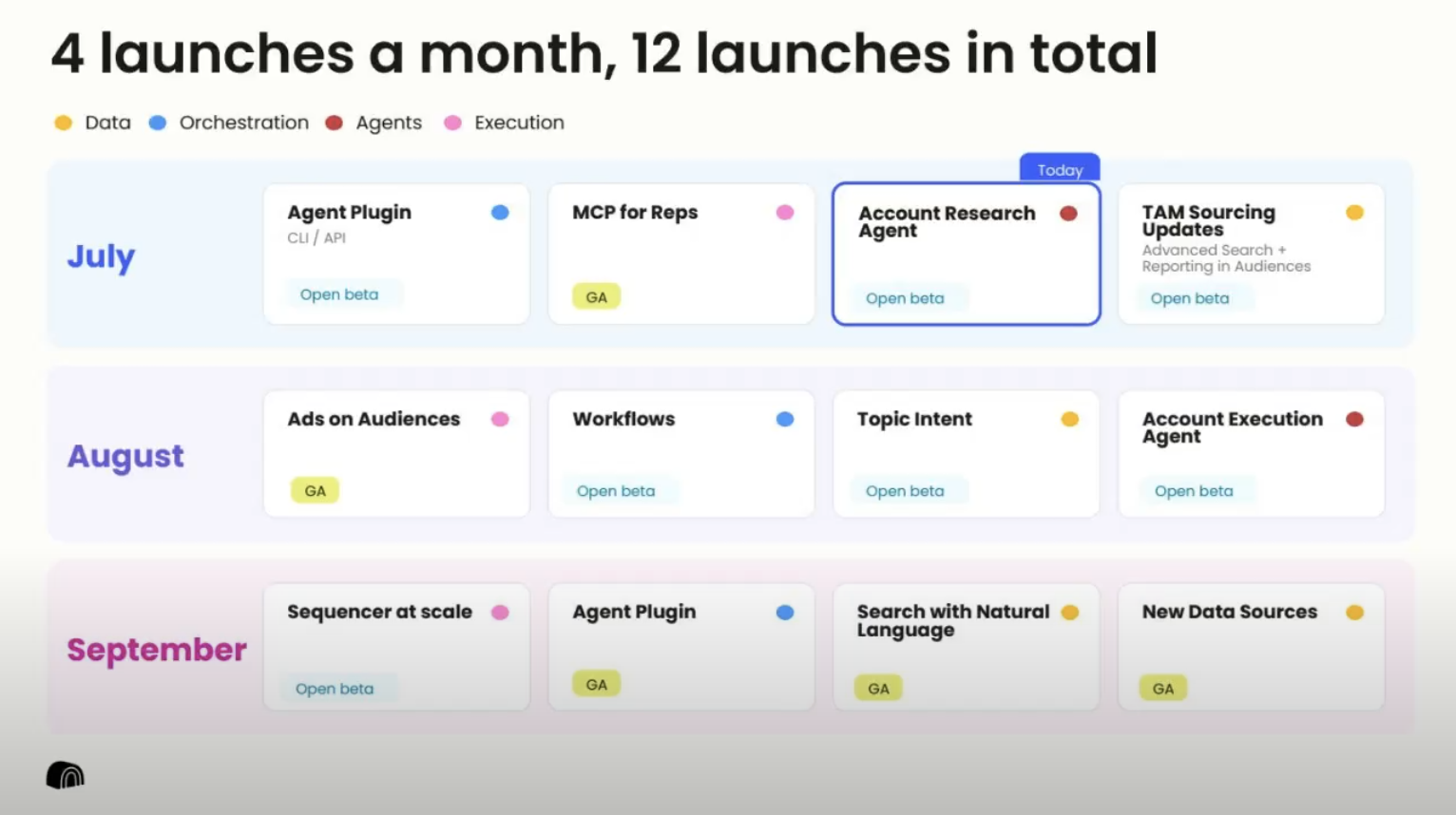
Clay's CEO Kareem Amin opened this week's livestream with a fairly bold claim: within a year or two, agents will run entire go-to-market plays on their own, and get better at it every time they run. Big claims from GTM vendors aren't rare. What's less common is watching one lay out, feature by feature, exactly how it plans to get there, and then ship most of it inside twelve weeks.
We use Clay across our own Smart Lead Generation work, so we watched the full session rather than skim a recap. This is hours old: there's no independent analyst coverage of any of this yet, so what follows is drawn from the livestream itself, cross-checked against Clay's own community and product pages where we could find them. Treat the roadmap dates as Clay's stated intentions rather than settled fact.
Amin's framing was that most GTM teams have spent the last few years buying better data, and that this alone no longer differentiates anyone. What separates teams now, in his telling, is whether they run one integrated system or a set of disconnected plays stitched together with brittle handoffs. An integrated system can see what worked and feed that back in. A disconnected one can't. Clay's answer is a three-layer stack: data (first-party CRM, warehouse and call data, plus third-party web enrichment), infrastructure (Audiences and Workflows, used to actually run a play), and agents that act on both, and improve over time. Amin's own term for the end state was a "self-improving revenue engine."
Amin described the business model as deliberately low-margin on data itself, weighted instead toward outcomes: meetings booked, productivity gained. Whether that holds as the product matures remains to be seen, but it's a more customer-aligned starting position than most usage-based GTM tools take.
In 2025, an event called Sculpt shipped six major features in one sitting, including the first version of Sculptor, Claygent Builder, and the original Audiences release. Most of what launched at Sculpt is now core to the product a year on. That doesn't guarantee the current twelve will land the same way, but it gives the timeline more weight than typical launch-day theatre.
Clay's search experience now runs three ways: natural language, expanded filters, and an agent-generated query language you can build inside Claude or ChatGPT and paste back into Clay. The most useful addition for account-based teams is what Clay is calling cross-entity filtering, searching for companies based on attributes of the people inside them, for example every company with ten or more software engineers, or every company currently hiring a VP of Engineering. There's also a new embeddings-based field for industry and product categories, which matters for anyone in a niche vertical: "crypto payment providers" isn't a standard industry taxonomy entry anywhere, but Clay's demo showed it resolving correctly to a relevant set of fintech accounts rather than returning nothing.
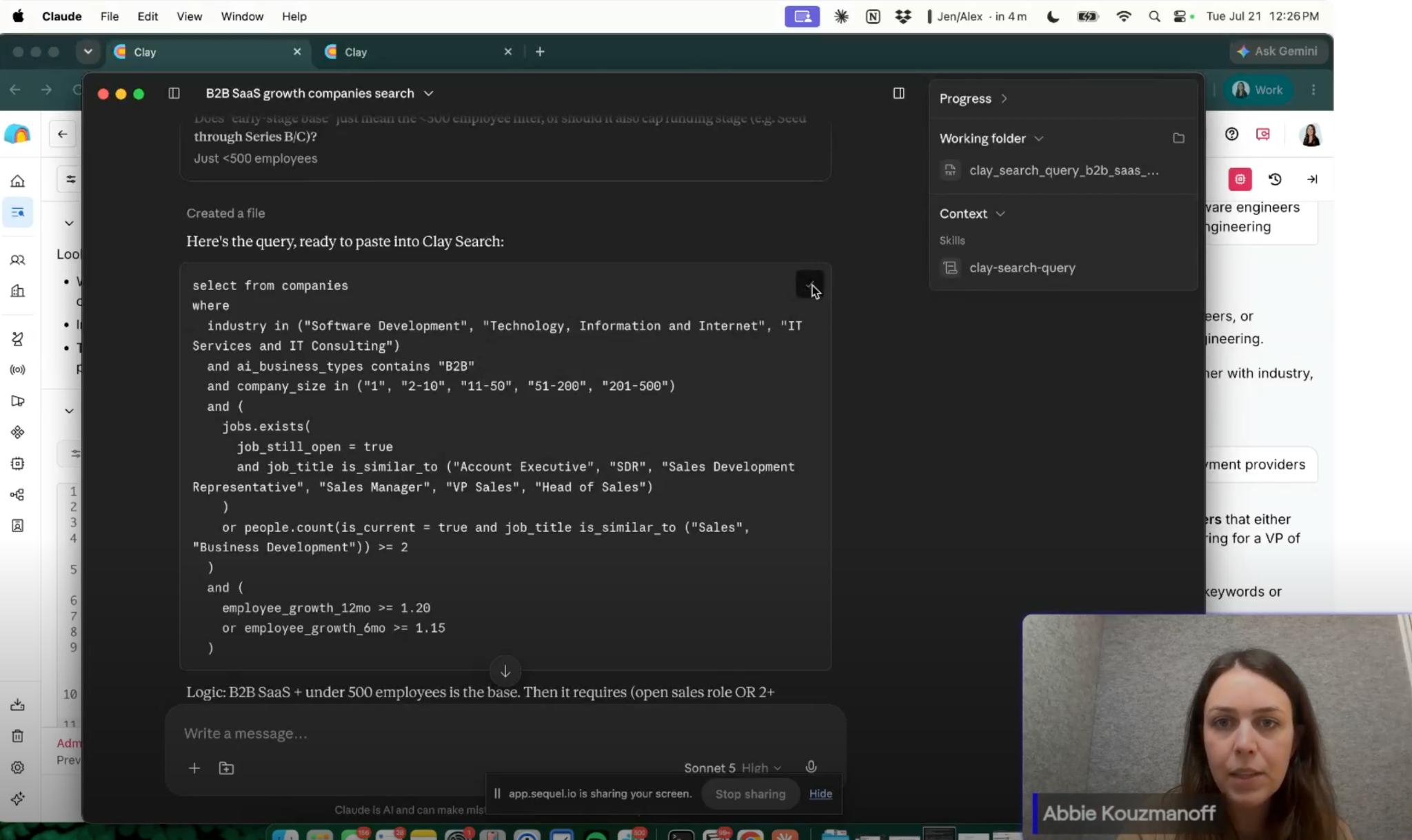
Searches built this way sync live into Audiences, so a saved search keeps adding newly qualifying companies automatically rather than sitting still as a one-off export. A new reporting tab sits alongside this, showing fill rates on key fields over time and, where the data exists, which pipeline and closed revenue traces back to records Clay itself sourced, enriched, or actioned. This is scheduled to open to all plans next week.
Clay's original table-based interface isn't going away, but Workflows is clearly positioned as where new building should happen. It's a visual, node-based canvas rather than a spreadsheet grid, without the row, column, or cell limits that table-based builds eventually hit. Two additions stood out. First, workflows support code nodes, meaning a deterministic Python step can sit inline for things like lead routing logic, rather than forcing every decision through a probabilistic model call. Second, every workflow can be read, written, and edited directly from Clay's CLI, including by an AI coding agent: the demo showed a workflow's ICP scoring criteria updated by pointing a Claude instance at a markdown file, with the change applied without touching the visual builder at all.
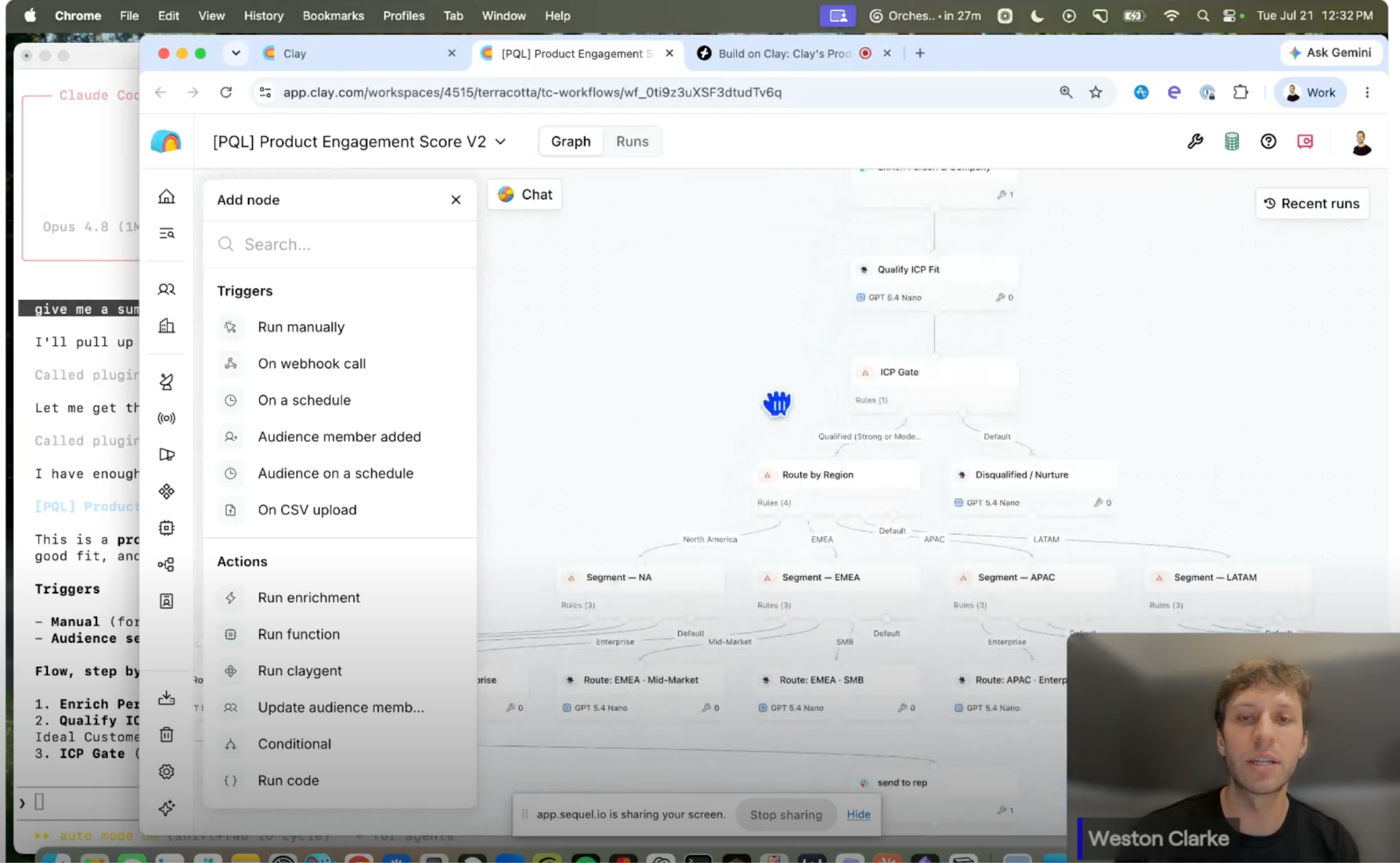
Every run is stored immutably and is fully searchable, which matters more than it sounds. For a lead-routing workflow specifically, that means being able to open any single run and see exactly which data points the workflow read, what it concluded from each one, and why a particular lead landed with a particular rep, rather than treating the workflow as a black box that either worked or didn't. Workflows is currently in closed beta, with a stated opening to all plans on 11 August. One closed-beta customer has reportedly already moved a workflow off n8n and onto Clay's own orchestration layer for that specific use case, though that's one data point, not a trend.
The single newest capability shown was Account Agents, which Clay's product lead for the feature said would go live within a day of the livestream. What was actually demoed sits on the research and scoring side: an agent reasons across everything Clay already holds on an account, CRM fields, call transcripts, email history, enrichment data, in one pass, and produces a specific output, a priority score, a rationale, a drafted email, a next best action. Underneath that sits an observability layer: for every conclusion the agent reaches, Clay surfaces which specific data point it used and what it inferred from it, down to a citation into a particular call or field. That's a meaningfully different design choice to a black-box score with no visible working, and it's the kind of thing that determines whether a sales team actually trusts and acts on the output or quietly ignores it. Clay's own materials separately list Account Execution Agents, agents that act on that recommendation directly rather than handing it to a person first, as a distinct capability. That wasn't shown on the call, so treat it as announced rather than demonstrated.
The execution side, syncing an Audiences segment directly to ad platforms, or running outbound through Clay's own sequencer, isn't new in concept but is being positioned as the natural final step: source the account, qualify it, decide the next action, then reach it wherever that action happens, without exporting a CSV between four different tools.
One thread ran through several audience questions and Clay's own answers: reps are not expected to log into Clay directly. The stated model is that reps interact through the Clay MCP connector inside Claude or ChatGPT today, with a dedicated Slack surface planned within one to two months. Clay itself, including the CLI, is aimed at RevOps and what Clay calls GTM engineers, the people building and maintaining the system rather than working leads day to day. If you're planning a rollout, design around that distinction from day one, rather than discovering it after reps have been handed logins they don't need.
Smart Lead Generation is our productised service for turning a defined ICP into booked meetings, and every engagement we deliver sits on the same three-step spine: Capture, Qualify, Activate, built in Clay and wired into HubSpot, HeyReach, and LinkedIn Sales Navigator on the other end.
Capture starts with a web intent pixel that resolves anonymous site traffic into company-level data, feeding a live Companies table in Clay in real time. Qualify runs that table against a second one holding the client's actual ICP, fund type or vertical, size, geography, and regulatory profile, with non-fit accounts falling away and matches moving forward automatically. Activate enriches the surviving accounts down to the right buying-committee contacts, then splits into two parallel channels: LinkedIn ABM audiences for paid reach, and sequenced outreach through HeyReach and HubSpot for direct contact. Every sequence goes through a compliance pass before it ships, checked against UK GDPR and PECR's corporate subscriber exemption, since B2B legitimate interest is the legal basis the whole channel rests on.
That's the system Clay's announcements land on top of. Here's what actually changes.
Advanced search and cross-entity filtering: opening to all plans next week. Account Agents: live within a day of the livestream. Workflows: open to all plans from 11 August, with workflow-level budgeting expected before then. Given how early this all is, we'd treat the launch dates as directional rather than guaranteed, and we'll be testing each of these against our own client accounts as they go live rather than taking the demo at face value. If you want to talk through what any of this means for your own GTM stack specifically, get in touch.
This is the standard our Smart Lead Generation service is built to, tested against our own accounts before it ever touches a client's. If you want to see how it would handle your own ICP, or you're already running lead generation on Clay and want a second opinion on your setup, get in touch.
Mapped against how we structure Smart Lead Generation work, the shift is fairly clean. Audiences and the new search layer strengthen Capture, a genuinely richer way to define and continuously refresh a target account list rather than a one-time export. Workflows and Account Agents both sit inside Qualify, doing the scoring and prioritisation work with a visible, auditable rationale rather than a static lead score nobody can explain months later. Ads and Sequencer close out Activate, the actual outreach. None of this changes the underlying framework. It does mean more of it can run as one connected system instead of four tools stitched together by hand, which was Amin's whole opening point.
Related Thinking
SEO
Christopher Smith

EVENTS

Rowland Marsh
Christopher Smith
Independently certified

