- Home
- Growth Revenue Engine
- AI
- Agentic Systems & Automations
Agentic Systems & AI Automation Consulting
For financial services and FinTech.
Agentic AI is how artificial intelligence graduates from a single chat window into infrastructure. We design and build the architecture underneath: multi-agent orchestration, the runners that execute the work, the tool and model assignments, the human-in-the-loop checks that keep them honest, the observability layer that proves they are working, and the governance framework that makes the whole thing defensible.
TRUSTED BY LEADING FINANCIAL SERVICES BUSINESSES

The challenge
Most agentic systems fail at the layer nobody talks about.
Everyone is building agents. Almost nobody is building the system underneath. Prompts chained together with no architecture. Workflows wired in low-code tools that break the moment anything changes. Agents calling other agents with no orchestration logic between them. No observability, so when something goes wrong, nobody knows what the agent actually did. No human-in-the-loop, so the agent has full autonomy from day one. No golden dataset, so there is no way to tell whether the system is improving or regressing. No audit trail, so compliance refuses to sign it off. The agent demos beautifully. The system collapses under any real load. Building agentic AI is not the hard part. Building the infrastructure that lets it run safely, observably and at scale is the hard part, and it is the part most teams skip.
What you get
-
Architecture before agents
Multi-agent system design with clear layers, dependencies and contracts between agents. The diagram and specification we can hand to engineering before a single agent is written.
-
Runners that actually run
AI agents engineered with tool and model assignment, retry logic, state management, error handling and structured I/O. Production code that holds under real-world load. Not chained prompts behind a UI.
-
Human-in-the-loop, by design
Validation gates, override mechanisms and golden dataset benchmarking. Every agent measured against a human baseline before it gets autonomy. The control plane that keeps you in charge of your AI estate.
-
Observability and audit by default
Logs, traces, dashboards, KPI frameworks and full audit trail. Leadership knows what every agent is doing. Compliance can sign it off. The system is defensible, not a black box.
Our AI approach
How we deliver Agentic Systems & Automation
We deliver agentic systems as a structured engineering engagement, not a research project. Every layer is scoped, designed and documented before code is written. Every agent is benchmark-tested before it goes into production. Every workflow has an override path. The work ends with a system your team can run, a documentation package they can extend, and a governance framework your compliance officer can sign off on.
-
01
Architecture and system design
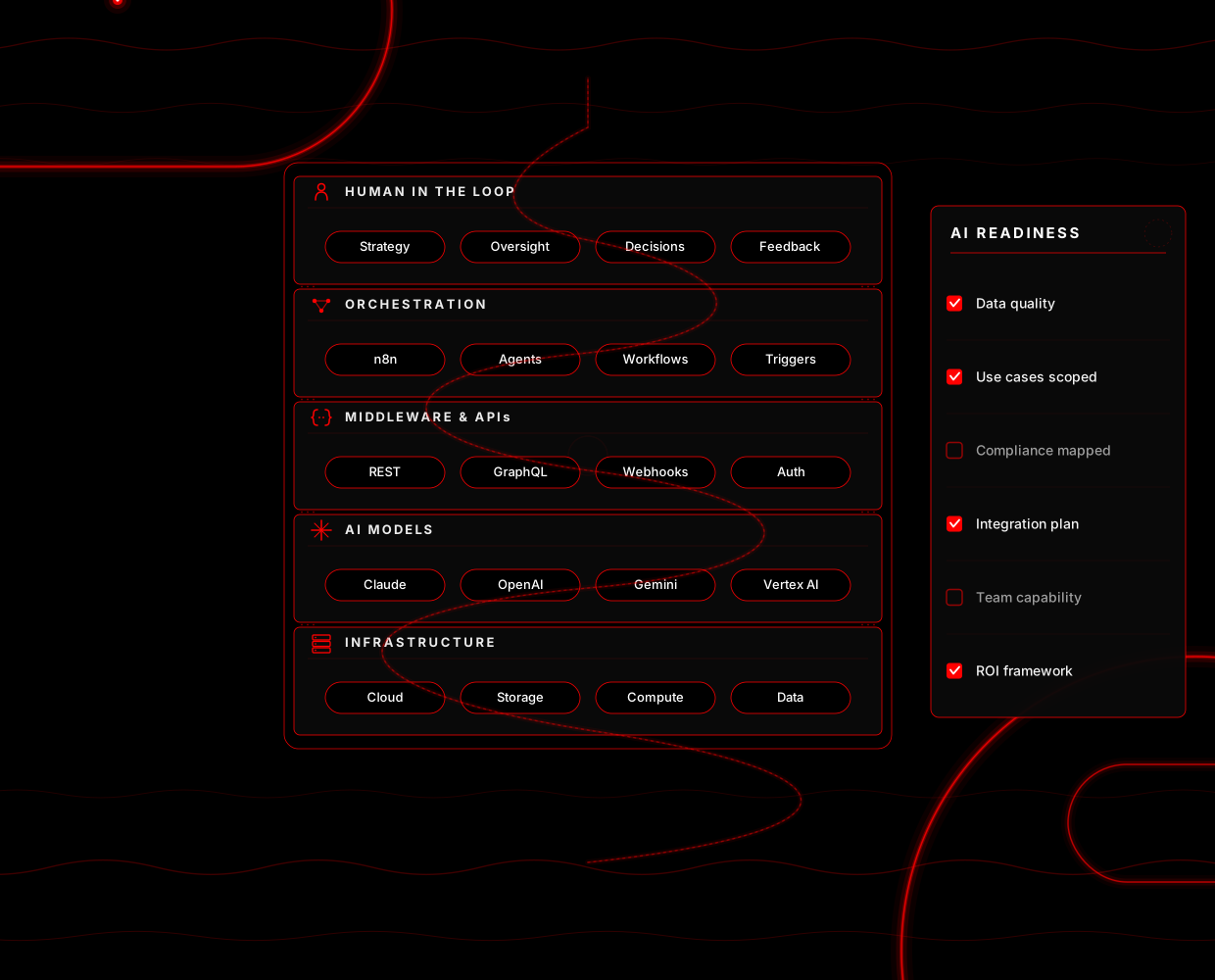
Agentic system architecture across all the layers your business actually needs: orchestration, agents, tools, models, memory, observability, governance and control. Agent and workflow mapping at the diagram level. Tool and model assignment per agent. Infrastructure and observability layer designed before build begins. Architecture diagrams, technical specification, dependencies and contracts, all documented.
-
02
Agent build and platform integration
AI agent design, build and validation in production-grade code. MCP integration and configuration so agents can use the tools they actually need. Platform AI feature implementation across HubSpot, Salesforce or your existing stack. Custom middleware and orchestration where the platform stops. Hosted infrastructure available where serverless functions or persistent middleware are part of the system.
4-layer agentic architecture. 9 parent agents. MCP integration. HubSpot AI activation. Built for a regulated FSI firm.
-
03
Validate against the human benchmark
Golden dataset definition for every workflow the system is meant to handle. Benchmark testing against a documented human baseline. Human-in-the-loop validation framework that determines which workflows get full autonomy, which require approval and which stay manual. Control plane and override mechanism design, so the system always has a clean stop.
-
04
Deploy, observe, govern
Production deployment with full observability: logs, traces, agent performance dashboards and a KPI framework that tracks accuracy, latency and intervention rate per agent. Audit trail and compliance documentation designed against FCA principles, Consumer Duty and your internal risk appetite. Ongoing monitoring and optimisation model so the system stays honest as agents, models and data drift over time.
Agentic Systems & Automation is part of the broader Growth Revenue Engine: Evara's integrated framework for scalable financial services growth.
- + 152 %
- ARR growth post-automation
- 4 x
- Sales scalability through agent-enabled workflows
- 300 +
- Systems deployed across the FinServ portfolio
CASE STUDIES
Results that speak for
FinTech and Financial Services.
-
PAYMENTS
40%
Pipeline Visibility Increase
How we restructured the commercial operating model at a FinTech payments business, embedding HubSpot CRM as the operational spine across marketing, sales and customer success.
-
DATA & ANALYTICS
+18%
Increase in revenue
Revenue uplift at a financial intelligence platform after we redesigned the sales process, built ~100 automated deal workflows and embedded enablement that scaled the sales team to 4x its original size.
Ready to see how an agentic system would work for your business?
No obligation. Response within 1 business day.
All our marketing efforts can now be tied into one campaign, which helps us analyse performance effectively. The buyer persona-based approach helps us customise messaging to what is most relevant. This improves conversion rates and results in more MQLs and SQLs for the Sales Team.

Priyanka Wani
Our website didn't reflect the company we are today. Our customers' expectations have changed, and we've grown our product suite massively. We needed a refresh to support our marketing goals, brand awareness, expert positioning, and lead generation.
Anna Flach
They got our CRM to finally work after we had tried to implement it internally over six months with starts and stops, never achieving our goals to properly attribute our marketing efforts.
Cledara
Increase in revenue within three months of implementation
Sales team expansion enabled by automation efficiencies
Increase in content engagement across the platform
increase in qualified pipeline within 6 months of GRE engagement
reduction in manual sales and marketing admin through automation
of clients report improved revenue visibility and forecasting accuracy
Attribution accuracy achieved across campaigns
Reduction in reporting time for marketing leadership
Full-funnel visibility from first touch to closed revenue
FREQUENTLY ASKED QUESTIONS
Common questions about agentic systems and AI automation.
An agentic AI system is software where one or more AI agents take actions in pursuit of a goal, rather than just generating text in response to a prompt. The defining features are autonomy (the system decides what to do next within defined boundaries), tool use (agents call APIs, databases, platforms and other tools), state (agents remember context across steps), and orchestration (multiple agents coordinate to complete work that no single agent could handle alone). For Financial Services and FinTech firms, agentic systems are how AI moves from generating content to actually executing parts of the commercial operating model, with the human-in-the-loop and audit trail that regulated environments require.
Developing an agentic AI system is an engineering discipline, not a prompt-writing exercise. Our approach starts with architecture: we map the agents required, the contracts between them, the tools and models each one is assigned, and the orchestration logic that coordinates the system. We then design the infrastructure layer (memory, observability, audit trail) before any agent is built. Agents are written as production code with retry logic, structured I/O, error handling and state management. Every agent is benchmarked against a human baseline using a golden dataset before it gets autonomy. The output is a working multi-agent system with documentation, dashboards and a governance framework, not a stack of prompts behind a no-code tool.
AI automation typically means deterministic workflows with AI embedded at specific decision points: an AI step inside a Zapier or n8n flow, an AI-enriched HubSpot workflow, a Breeze AI assistant that summarises a deal record. The flow itself is predefined, the AI just makes one or two decisions inside it. Agentic AI is the opposite: the AI agent decides what to do, in what order, using what tools, within boundaries set by the system architecture. AI automation is appropriate when the workflow is well-understood and can be hard-coded. Agentic AI is appropriate when the work involves judgement, multi-step reasoning or coordination across systems. Most production-grade financial services AI estates need both, used deliberately, not one applied where the other fits better.
Human-in-the-loop is a design principle, not a checkbox. In practice it means three things. First, a validation framework: every workflow the system is meant to handle has a documented human baseline before any agent is allowed to run it autonomously. Second, gating: workflows are classified into autonomy levels, full autonomy, approval-required, recommended-only, manual-only, based on risk and confidence. Third, an override mechanism: every agent has a documented stop, audit and override path that a human can invoke at any point. Without all three, "human-in-the-loop" is marketing language. With all three, it is the difference between an AI system your compliance officer signs off on and an AI system your compliance officer shuts down.
More than most teams plan for. A production agentic system needs an orchestration layer that routes work between agents and handles state. An observability layer that captures logs, traces and agent decisions in a queryable form. A memory layer that holds context across runs. Tool and API access via MCP (Model Context Protocol) or equivalent. A control plane for permissioning, override and audit. A benchmarking pipeline that compares agent outputs against the golden dataset on every release. A KPI framework that measures accuracy, latency, intervention rate and drift over time. We design and build all of this as part of the engagement, either deployed onto your infrastructure or hosted as middleware and serverless functions where persistent infrastructure is part of the scope.
Compliance is designed into the architecture, not retrofitted after the agents are running. Every agent has a documented purpose, data sources, model assignment, tool permissions and override path. Every agent action is logged with full lineage so audit trails can be reconstructed. The system is scoped against FCA principles, Consumer Duty obligations, SMCR personal accountability and your internal risk appetite before build begins. Workflows touching protected categories (advice, decisioning, customer communications) are subject to stricter gating and validation than internal-facing workflows. The governance framework is documented as part of the engagement, so internal audit, external auditors and the FCA all have a defensible record of how the system was designed and what controls are in place.
Yes, with two distinct approaches. Inside the platform: we activate and configure native AI features (HubSpot Breeze AI, Salesforce Einstein), build custom Breeze assistants and custom workflows that use the platform's native AI. This is the right approach when the work belongs inside the CRM. Above the platform: when the work spans multiple systems or requires capabilities beyond what the platform's AI exposes, we build agents and middleware that sit above the platform and integrate through APIs and MCP. Most production financial services AI estates use both. For deeper HubSpot AI implementation specifically, see our HubSpot Services page.
A focused single-agent or platform-AI activation typically runs between 4 and 12 weeks. A multi-agent architecture build with infrastructure, observability and human-in-the-loop validation typically runs between 12 and 24 weeks, depending on the number of agents, the systems they integrate with and the depth of governance required. Engagements are scoped after the AI Strategy & Readiness phase, where we score readiness across data, process, platform, governance and team. The readiness assessment determines whether the build is feasible, how it should be phased and where the risk concentrations are. Most firms get more value from a smaller, fully governed multi-agent system than from a larger ungoverned one, so we tend to recommend tighter initial scopes and structured expansion.
Have more questions about agentic systems, infrastructure or governance? Get in touch.
SUPPORTING SOLUTIONS
Related capabilities
-
REPORTING & BUSINESS INTELLIGENCE
Clean data is the prerequisite for AI.
Data models, dashboards and decision frameworks that turn your data into an AI-ready foundation. The work that determines whether your AI strategy is buildable.
-
AI STRATEGY & READINESS
Strategy and readiness come before the build.
AI strategy, readiness assessment and governance framework. The work that scopes which use cases the build phase should target, and which ones are not yet defensible to attempt.
-
HUBSPOT SERVICES
Activate Breeze AI inside the platform.
Where the agentic system reaches into HubSpot, we configure the platform's native AI features alongside the custom architecture. The two layers operate as one system.
TALK TO US
Start the conversation.
Tell us what you have tried and where it broke. We will respond within one business day with a clear next step.
No obligation · Response within 1 business day · We respect your data.
Latest Insights
New insights on agentic systems and AI automation for Financial Services and FinTech companies are published each month. Explore more information on Growth Revenue Engine and the technical aspects of AI Strategy and AI Readiness.
GET IN TOUCH
Let's talk about agentic systems and AI automations.
No obligation. Response within 1 business day.