- Home
- Growth Revenue Engine
- AI
- AI Operations & Optimisation
AI Operations and Optimisation Consulting
Built for financial services and FinTech.
We help Financial Services and FinTech firms move AI from disconnected experiments into reliable, measurable operations. Tooling, integration, knowledge enablement, process redesign, team adoption and AI governance, delivered as one connected practice and engineered against the AI roadmap your business has actually committed to. The work that turns the AI budget into operational advantage, instead of a growing line item attached to outcomes nobody can defend.
TRUSTED BY LEADING FINANCIAL SERVICES BUSINESSES

The challenge
The AI investment is real. The operational return is not.
Most Financial Services firms now spend meaningfully on AI. Enterprise licences for ChatGPT, Copilot or Claude. Specialist tools for analytics, content, sales enablement and customer support. Custom GPTs and prompt libraries that someone built three months ago and nobody has touched since. The investment is real. The operational return is not. Adoption is patchy. Integration with the CRM, CMS and analytics stack is partial or non-existent. Internal knowledge is locked inside PDFs and Slack threads that AI tools cannot retrieve cleanly. Governance is a Slack channel rather than a framework. Performance is anecdotal rather than measured. The result is an AI budget growing year-on-year, attached to operational outcomes nobody can defend in a quarterly review. The discipline this page describes is the alternative: AI operations engineered the way the rest of the business is engineered, designed against the work your teams actually do, governed against the regulatory perimeter you actually operate inside.
What you get
-
AI tools that connect to the systems you already run
Selection, configuration and integration of AI tools with your existing CRM, CMS, analytics, project management and internal platforms. Salesforce, HubSpot, Pipedrive, Microsoft and Google connected to ChatGPT Enterprise, Claude, Copilot, Glean, Notion AI or whichever AI tools your strategy commits to. No standalone AI experiments. Everything routed back to the systems your teams already work in.
-
Knowledge and data ready for AI to actually use
Internal documentation, content libraries, structured data and process knowledge organised, cleaned and tagged so AI systems can retrieve, interpret and use it accurately. The work that turns generic AI tools into systems that know your business specifically — your products, your sub-vertical vocabulary, your compliance posture and your client context.
-
Teams that actually use AI, not just sign in to it
Practical playbooks, prompt libraries, workflow design and training programmes that turn AI access into AI usage. Process optimisation that embeds AI assistance into the workflows people already run. Measured adoption against active-user, time-saved and output-quality benchmarks, not against licence counts that flatter the dashboard but mean nothing operationally.
-
Governance, quality and continuous improvement
Usage guidelines, quality checks, AI governance frameworks and the continuous optimisation practice that makes AI reliable enough for regulated financial services use. Compliance-aware governance designed against your sub-sector's regulatory perimeter, not against generic enterprise AI templates that ignore FCA, Consumer Duty and SMCR exposure.
Our AI approach
How we deliver AI Operations & Optimisation
We deliver AI Operations as a structured engagement that runs from audit through to governed, measured day-to-day operation. Every phase is sequenced against the AI roadmap your business has already committed to and the regulatory perimeter you operate inside. No standalone tooling. No unmeasured pilots. No experiments that never become operational.
-
01
Audit current AI usage and operational readiness
Full audit of AI tools licensed, AI tools actually used, AI tools forgotten about, and AI tools the team is using outside official approval. Data and knowledge readiness assessment across documentation, content libraries, CRM and internal platforms. Process maturity review against where AI assistance would compound. Team adoption diagnostics. Governance gap analysis against your sub-sector's regulatory perimeter. Output: a prioritised AI operations roadmap with each finding scored against effort, impact and dependency.
-
02
Design tooling, knowledge and process architecture
Tooling architecture designed against your stack: which AI tools earn their place, which get consolidated, which get integrated with which platforms, which retire. Knowledge and data enablement design: how documentation, content, CRM data and process knowledge get structured for accurate AI retrieval and interpretation. Process redesign workshops with the teams the AI work will affect. AI governance framework drafted against FCA, Consumer Duty, SMCR and sub-sector specifics.
70% adoption increase across CRM and platform engagements. 60% faster operational cycles post-engagement. Governance designed against FCA principles, not against generic enterprise templates.
-
03
Build, integrate, train and enable
AI tool integration into the existing stack via native connectors, MCP or custom integration where required. Knowledge base preparation and structuring for accurate AI retrieval. Playbook library and prompt library creation, tailored to your sub-sector and use cases. Team training and rollout sequenced against the adoption diagnostics from Step 01. Active-user, time-saved and output-quality measurement built in from cutover day, not bolted on later.
-
04
Govern, measure and continuously optimise
Quality assurance, output review and usage governance running as a structured monthly cadence. Performance measurement tied to operational KPIs and pipeline outcomes, not to usage statistics in isolation. Continuous optimisation cycle that reallocates investment toward what is working and retires what is not. Audit trail for every governance review, ready for FCA, SMCR and internal audit scrutiny.
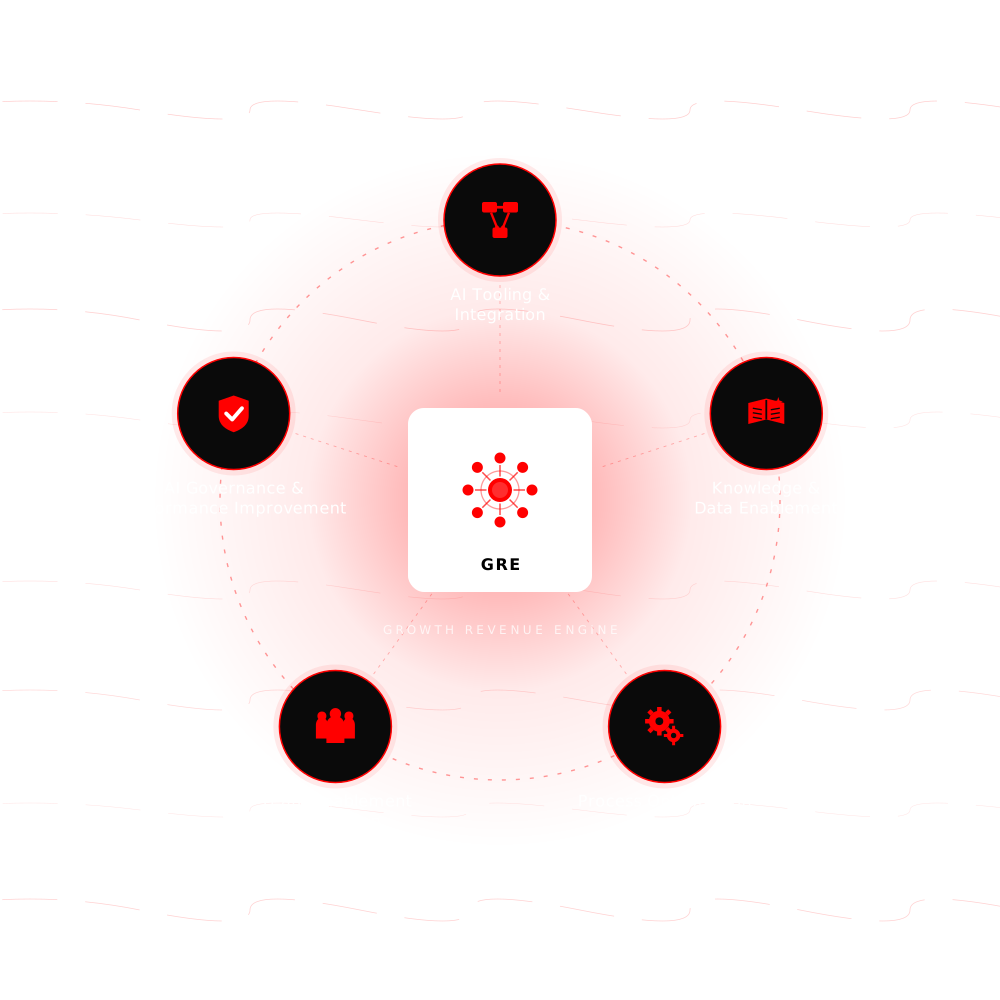
AI Operations & Optimisation is part of the broader Growth Revenue Engine: Evara's integrated framework for scalable financial services growth.
- 150 +
- Financial Services companies trust us
- 30
- Financial services sub-sectors covered
- 9 +
- Years sector expertise
CASE STUDIES
Results that speak for
FinTech and Financial Services.
-
PAYMENTS
40%
Pipeline Visibility Increase
How we restructured the commercial operating model at a FinTech payments business, embedding HubSpot CRM as the operational spine across marketing, sales and customer success.
-
DATA & ANALYTICS
+18%
Increase in revenue
Revenue uplift at a financial intelligence platform after we redesigned the sales process, built ~100 automated deal workflows and embedded enablement that scaled the sales team to 4x its original size.
Ready to see how AI Operations would work for your business?
No obligation. Response within 1 business day.
All our marketing efforts can now be tied into one campaign, which helps us analyse performance effectively. The buyer persona-based approach helps us customise messaging to what is most relevant. This improves conversion rates and results in more MQLs and SQLs for the Sales Team.

Priyanka Wani
Our website didn't reflect the company we are today. Our customers' expectations have changed, and we've grown our product suite massively. We needed a refresh to support our marketing goals, brand awareness, expert positioning, and lead generation.
Anna Flach
They got our CRM to finally work after we had tried to implement it internally over six months with starts and stops, never achieving our goals to properly attribute our marketing efforts.
Cledara
Increase in revenue within three months of implementation
Sales team expansion enabled by automation efficiencies
Increase in content engagement across the platform
increase in qualified pipeline within 6 months of GRE engagement
reduction in manual sales and marketing admin through automation
of clients report improved revenue visibility and forecasting accuracy
Attribution accuracy achieved across campaigns
Reduction in reporting time for marketing leadership
Full-funnel visibility from first touch to closed revenue
FREQUENTLY ASKED QUESTIONS
Common questions about AI Operations & Optimisation
AI Operations & Optimisation is the discipline of making AI a reliable, measurable part of how a business runs day-to-day, rather than a collection of disconnected experiments. The work covers five connected components. First, AI tooling and integration: selecting, configuring and connecting the right AI tools with your existing CRM, CMS, analytics, project management and internal platforms. Second, knowledge and data enablement: structuring internal documentation, content and data so AI systems can retrieve, interpret and use it accurately. Third, process optimisation: redesigning workflows with AI assistance, better handoffs and faster decision-making built in. Fourth, team enablement and adoption: training, playbooks, prompt libraries and the practical habits that turn AI access into AI usage. Fifth, AI governance and performance improvement: usage guidelines, quality checks, measurement frameworks and the continuous optimisation practice that makes AI reliable, safe and scalable. We deliver all five as one engagement.
The three AI practices serve different points in the AI lifecycle. AI Strategy & Readiness is the upstream work: assessing whether and how AI applies to your business, prioritising use cases, drafting the governance framework and producing the roadmap that decides what gets built and in what order. Agentic Systems & Automation is the build work: bespoke multi-agent systems, MCP-based architecture, custom automation infrastructure and complex orchestration where off-the-shelf tools cannot do the job. AI Operations & Optimisation is the operational work: turning the AI roadmap into day-to-day operational practice, embedding existing AI tools into existing workflows, training teams, measuring adoption and governing usage at scale. Most clients engage with two or three of these in sequence: Strategy first, then Operations (with Agentic where the build complexity justifies it).
AI governance consulting covers the policies, frameworks, controls and measurement practices that make AI safe, compliant and scalable inside an organisation. Our AI governance consulting work includes usage guidelines (what AI tools can be used for what, by whom, with what oversight), data and content controls (what data can be sent to which AI tools, how outputs are validated), quality assurance frameworks (how AI-generated content, decisions and recommendations are reviewed), measurement frameworks (how AI performance is tracked against operational KPIs), incident response procedures (what happens when AI produces an error, hallucination or compliance-relevant output) and the audit trail discipline required for FCA, Consumer Duty and SMCR oversight. For Financial Services firms, governance is not optional — and generic enterprise AI governance templates do not survive contact with a regulated business. We design the framework against your sub-sector's regulatory perimeter from the first workshop.
AI tooling and integration is the work of selecting, configuring and connecting AI tools to the systems your teams already run. We are platform-agnostic — the right tool depends on your use cases, regulatory perimeter, existing stack and team maturity. We work across the major AI platforms (ChatGPT Enterprise, Claude, Copilot, Gemini), the major operational AI tools (Glean, Notion AI, Perplexity Pro, Glean), the major workflow AI tools (Zapier AI, Make, n8n with AI nodes) and the major sector-specific AI tools that have emerged across FinServ and FinTech. Integration is delivered through native connectors where they exist, MCP where the architecture supports it, and custom integration where the operational case justifies the build. The output is AI tools that route back into the systems your teams already use (HubSpot, Salesforce, Pipedrive, Microsoft, Google) rather than standalone AI experiments that nobody opens.
Knowledge and data enablement is the work that makes AI tools actually useful inside your business specifically, rather than generically. The work covers documentation enablement (cleaning, tagging and structuring internal documentation for accurate AI retrieval), content enablement (organising marketing content, sales collateral and product information so AI systems can use it), data enablement (cleaning CRM data, structuring product data, unifying customer records) and process enablement (capturing institutional knowledge that lives in people's heads and turning it into structured prompts, playbooks and workflows AI can execute against). For Financial Services firms, this work has additional complexity because compliance-sensitive content needs explicit handling: what AI tools can see, what they can output, what gets reviewed before reaching a client. We design the enablement programme against the AI use cases the strategy roadmap commits to, not as a generic data cleanup project.
AI adoption is the difference between an AI budget and AI operations. Most enterprise AI rollouts fail at this stage — licences are issued, training is generic, adoption is patchy and the investment never converts to operational outcomes. Our AI adoption work runs on four layers. First, adoption diagnostics: where are teams now, what blockers exist, what habits need to change. Second, practical playbooks and prompt libraries tailored to specific roles and workflows — not generic "10 ChatGPT prompts" training, but role-specific playbooks that show a sales rep, an underwriter, a compliance analyst or a marketer how AI applies to the work they actually do. Third, embedded workflow design: AI assistance built into the workflows people already run, with handoffs, quality checks and escalation paths designed in. Fourth, measurement against active-user, time-saved and output-quality benchmarks. Reporting goes to leadership, not just to IT.
Measurement is built into the engagement, not bolted on later. We measure AI operations against four layers of metrics. First, adoption metrics: active-user rate by role, weekly engagement, tool-by-tool usage versus licence count. Second, efficiency metrics: time saved per task, cycle time reduction, throughput improvement against documented baselines. Third, quality metrics: output review rates, error frequency, customer-facing quality scoring where AI touches client communications. Fourth, business impact metrics: pipeline impact, conversion impact, cost-to-serve reduction, revenue impact attributable to AI-assisted operations. The fourth layer is what makes the engagement defensible in a quarterly review. The other three layers are the operational discipline that produces the fourth. Reporting connects to the broader Business Intelligence layer where it exists — see our Reporting & Business Intelligence page for the underlying BI infrastructure.
Have more questions about AI operations, governance or adoption in regulated environments? Get in touch.
SUPPORTING SOLUTIONS
Related capabilities
-
REPORTING & BUSINESS INTELLIGENCE
Clean data is the prerequisite for AI.
Data models, dashboards and decision frameworks that turn your data into an AI-ready foundation. The work that determines whether your AI strategy is buildable.
-
CRO & OPERATIONAL EFFICIENCY
Conversion at every stage of the journey.
UX, behavioural insight and experimentation applied to the friction points your GTM model surfaces. Improvements that compound across the funnel.
-
TECHNOLOGY & CRM ARCHITECTURE
Map the system before you build it.
Data model, integration logic and governance, defined before implementation begins. The work that determines whether the migration succeeds long term.
TALK TO US
Start the conversation.
Tell us what AI tools you have, what's working, what isn't, and where adoption or governance is falling short. We will respond within one business day with a clear next step.
No obligation · Response within 1 business day · We respect your data.
Latest Insights
New insights on AI operations, adoption and governance in regulated Financial Services are published each month. Explore more information on Growth Revenue Engine and the technical aspects of AI Strategy and AI Readiness.
GET IN TOUCH
Let's talk about AI operations and optimisation.
No obligation. Response within 1 business day.