
.svg)
.svg)


FINTECH MARKETING

Sheila Mitham
27 Jul 2017

For a few months, nobody notices. Enquiries are down slightly, but slightly is easy to explain away: a slow quarter, a change on the sales team, a seasonal dip. Then someone in a leadership meeting finally asks the question out loud: why has organic dried up? Whoever looks into it usually finds the decline has been running for months, sometimes stacked across two or three Google updates nobody was watching for. That's the moment most companies start paying real attention to their SEO. It's also, by definition, too late to fix calmly.
This matters beyond the company itself, because whoever gets called in at that point inherits the same posture. There's no runway to diagnose properly, only pressure to show a fast win, and a fast win produced under pressure tends to look like patchwork: more content, a quick technical fix, a link push, layered on top of whatever caused the decline in the first place rather than a real diagnosis of it. A reactive client makes for a reactive agency. Reacting to a problem isn't the mistake. Only noticing it once it's already large is.
Most SEO commentary draws this line as proactive versus reactive, and usually means something narrower by "reactive" than what actually causes damage. The textbook version treats reactive SEO as newsjacking: timely content built around a holiday, a trend, a piece of breaking news relevant to the industry. That's a legitimate, healthy tactic, and it's not what this is about.
The distinction that actually matters is reactive versus responsive. Reactive means SEO only gets attention once something has visibly broken: leads down, a client or an exec asking why traffic cratered. By the time anyone looks, the damage has usually compounded. Responsive means monitoring is built into the relationship continuously, so a dip in one keyword cluster gets a conversation and a fix within weeks, not discovered eighteen months later as a collapse. Responsive doesn't claim to predict everything before it happens. It just means staying close enough to the signals that nothing is allowed to compound unnoticed.
ClickUp's blog fell from 1.19 million monthly visitors in January 2025 to 28,790 by April 2026, a 97.6% collapse in fifteen months. The easy explanations don't hold up. It wasn't backlinks: ClickUp's domain rating rose from 87 to 90 across the same period, and referring domains grew 28%. It wasn't simple topical overreach either, the popular theory in SEO commentary: ClickUp's own core commercial keywords, "task management software," "free project management software," were hit exactly as hard as unrelated content, both falling from thousands of monthly visits to essentially one.
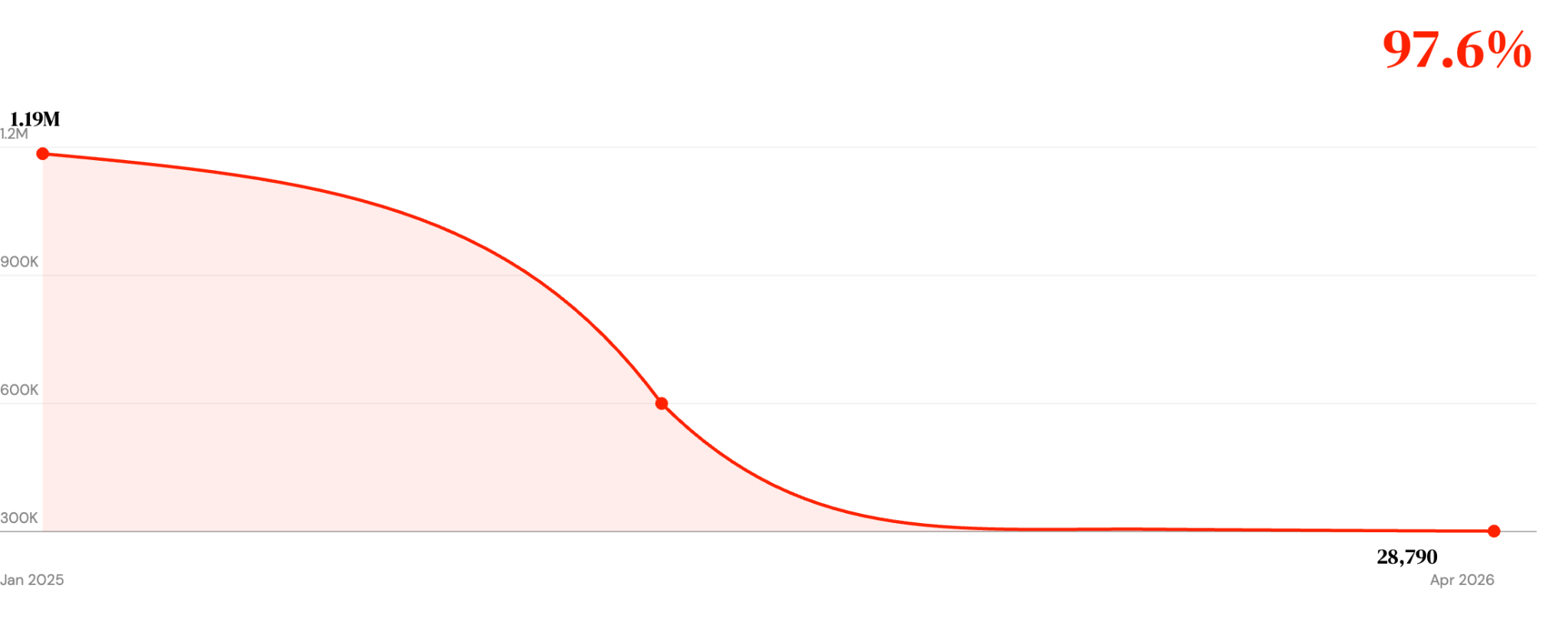
What the page-level analysis found instead was a single rigid, self-promotional template scaled across more than 7,000 posts. Every listicle ranked ClickUp first, including a "best ChatGPT alternatives" post that placed ClickUp at the top while its own text acknowledged ClickUp runs on ChatGPT under the hood. ClickUp's own section ran four to seven times longer than the average competitor entry, depending on the page.
The most telling detail for this argument isn't the template itself, though. It's what happened once traffic started falling. Instead of pausing to diagnose, ClickUp published 2,815 more posts using the exact same template over the following sixteen months, while traffic kept falling, and removed fewer than 1% of what already existed. That's reactive behaviour continuing even after the problem was visible: the response to a quality signal was more volume of the exact thing that triggered it. For comparison, Zapier runs a similarly broad blog strategy and was targeted by the same spam backlink network, but with far more restrained self-promotion, and only fell 53% against ClickUp's 97.6%.

Three things make this more expensive in financial services and fintech than it was for a project management tool.
Compliance-reviewed content can't be patched overnight the way a generic SaaS post can. A reactive scramble that might take an afternoon elsewhere takes a review cycle here, so the cost of discovering a problem late is higher by design, not by circumstance.
Trust-sensitive buyers notice self-promotional patterns faster when the decision involves who handles their money or their compliance obligations, so the reputational cost of being caught reactive, publishing more of what caused a decline rather than fixing it, lands harder in this category than in a lower-stakes purchase.
Longer sales cycles mean a quiet six-month organic decline is a much bigger pipeline hole to climb out of than it would be for a faster-moving product, since the leads lost during those six months were already several months into a cycle that won't repeat itself on the same timeline.
It's less dramatic than it sounds, mostly because that's the point. A small ranking dip gets a same-week look rather than a line in a monthly report nobody reads closely. Pruning and consolidation happen on a continuous cadence, not as an emergency measure once a core update has already done the damage. Whoever is managing the account already knows it well enough to notice a problem forming before the client does, because noticing early is the actual job, not the fast rebuild after the fact.
This is the same standard we hold our own SEO and AEO work to: audits, technical fixes, and structured data corrections delivered on an ongoing basis, not mass content production followed by a crisis response when a chunk of it stops working.
So, is your current setup reactive or responsive? One of those means you find out about a problem from a graph. The other means you find out from a conversation, weeks earlier.
Related Thinking
FINTECH MARKETING
Sheila Mitham

HUBSPOT

Mihai Jepan
DIGITAL MARKETING

Christopher Smith